June is National Safety Month, and last week’s theme, Avoiding Accidents, serves as an important reminder: most incidents don’t happen because someone intended to take a risk. More often, they occur when small steps are skipped, assumptions are made, or routine tasks become so familiar that hazards fade into the background.
The word “accident” itself can be misleading. It suggests an unavoidable event. In reality, many workplace injuries are preventable.
According to the National Safety Council, preventable injuries remain one of the leading causes of death in the United States. In 2024 alone, there were 4,337 preventable workplace deaths nationwide, despite a slight improvement from the previous year. The Centers for Disease Control and Prevention reports that unintentional injuries caused nearly 197,500 deaths in 2024, making them the third-leading cause of death in the country.
Those numbers are sobering. But they also reinforce an important truth: prevention matters.
In the compressed gas industry, avoiding accidents rarely comes down to a single action. It is the result of hundreds of decisions made every day:
- Taking a few extra seconds to inspect equipment before use.
- Reading and following procedures instead of relying on memory.
- Using the correct personal protective equipment.
- Speaking up when something doesn’t look right.
- Stopping work to ask questions rather than making assumptions.
- Sharing near-misses so others can learn from them.
Strong safety cultures are built through repetition. They are reinforced through training, communication, and visible reminders that safety is everyone’s responsibility, regardless of role or experience level.
That is one reason why the Compressed Gas Association continues to expand its library of free safety resources designed for end users and frontline employees. While technical standards remain essential, practical tools that communicate key messages clearly and quickly can help prevent mistakes before they happen.
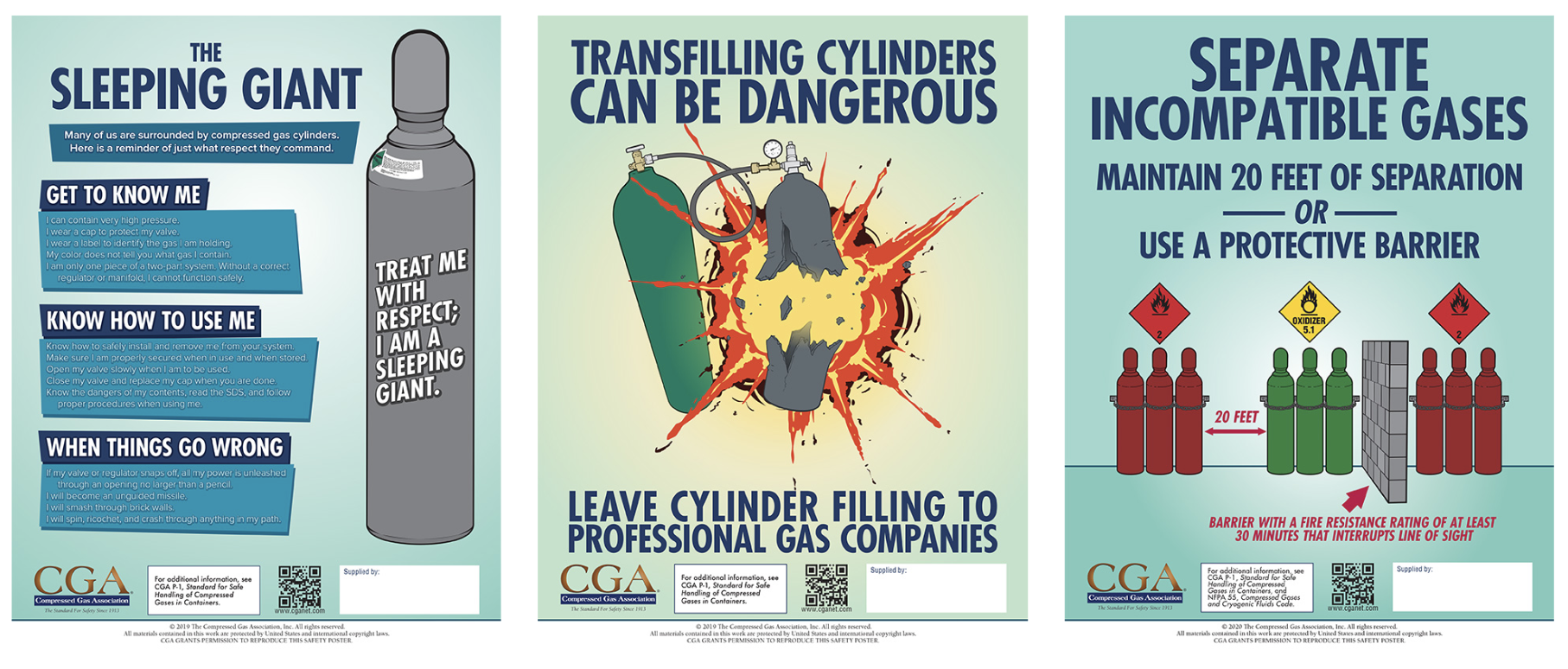
CGA’s free safety posters cover topics including home oxygen, dry ice, liquid nitrogen, medical oxygen, hydrogen, cylinder handling, carbon dioxide, flammable gases, and more. Organizations can download, print, and even customize these materials with their own branding and contact information to support training and awareness efforts.
This National Safety Month, take a few minutes to evaluate the simple actions that help keep your people safe. Review procedures. Refresh training. Talk about recent near-misses. Replace worn signage. Download a poster and hang it where it will be seen.
Avoiding accidents isn’t about achieving perfection. It’s about creating an environment where doing the safe thing becomes the easy thing.
Because the incidents we prevent are often the ones we’ll never hear about—and that’s exactly the point.